


Synthetic diamond
Sep 02, 2024
Mineralogy, informs us that both graphite and diamond share the same chemical component: carbon. Because their different crystal structures, graphite is soft, while diamond is hard.
Let me explain further:
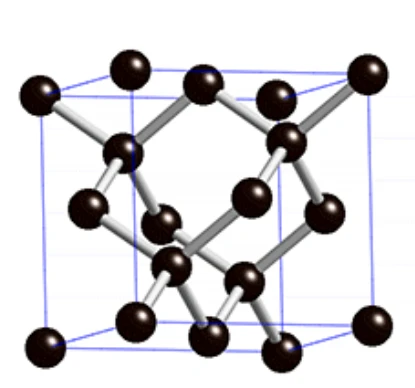
The diamond's structure is a face-centered cubic arrangement made up of tetrahedral , where each tetrahedron's central carbon atom is covalently bonded in a strong, direct connection to the four carbon atoms at the vertices. Due to the saturable and directional nature of covalent bonds, the structure becomes exceptionally robust.
To further clarify:
Diamond's framework is characterized by a face-centered cubic lattice comprised of interconnected tetrahedra. Within each tetrahedron, the central carbon atom forms covalent bonds with the four surrounding carbon atoms at the corners.
The inherent properties of covalent bonds, specifically their saturation and directionality, contribute to the extreme stability and strength of this arrangement.
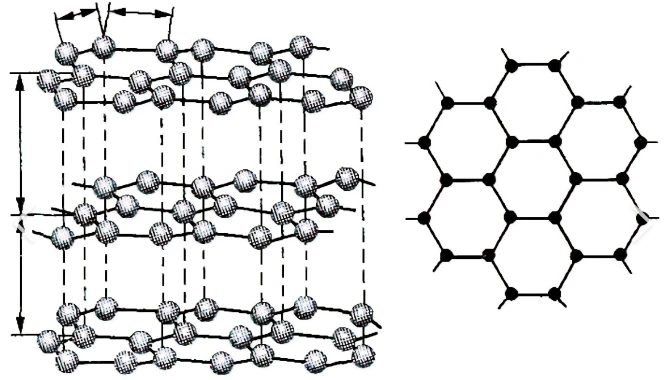
The crystal structure of graphite is shown in the figure, where the carbon atoms are arranged in planar hexagonal layers, with the distance between carbon atoms within the plane being small and bonded by covalent bonds, which are strong and firm. The distance between carbon atoms in adjacent layers is large, bonded by van der Waals forces, which results in the soft texture of graphite. Therefore, graphite is also a lubricant.
The basic principle of artificial diamond production is to alter the layered hexagonal structure of graphite into a face-centered cubic structure of diamond. Synthetic diamonds are all converted from graphite under conditions of about 5.6 to 6 GPa of pressure and temperatures of about 1300 ℃.


